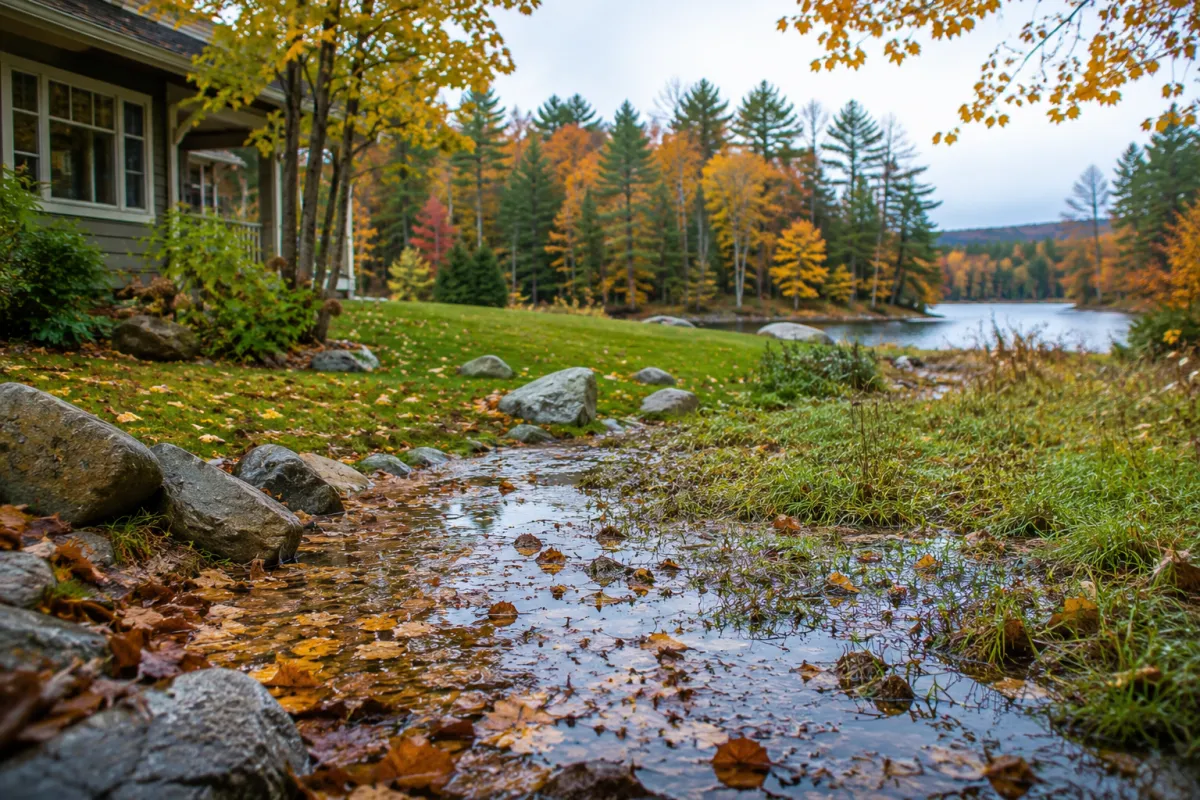
What Fall Can Tell You About Your Property’s Water
What Fall Can Tell You About Your Property’s Water
The changing seasons can reveal more about your property’s water resources than you might think.
As summer fades into fall across New Hampshire, cooler temperatures and changing precipitation patterns begin to shift the way water moves through the landscape. Leaves change, lawns go dormant, and areas of a property that looked dry in July may suddenly become wet or saturated.
For homeowners, these seasonal changes can provide valuable clues about what is happening beneath the surface.
At Edgewater Strategies, we look at water from both above and below the ground. Understanding groundwater movement, drainage patterns, springs, seepage, and seasonal changes can help property owners make more informed decisions about their land and prepare for potential water-related challenges.
Here are a few things to pay attention to this fall.
Groundwater Levels Change With the Seasons
Groundwater isn't static. It naturally rises and falls throughout the year depending on precipitation, snowmelt, evaporation, vegetation, and how much water is being withdrawn from the ground.
After a dry summer, groundwater levels may be lower than they were in the spring. As fall rains arrive, some of that water begins infiltrating into the soil and replenishing groundwater supplies.
But that process doesn't happen instantly.
Rainfall first moves through the soil, where some water is absorbed by plants, some runs off across the surface, and some continues downward to recharge groundwater. The amount that actually reaches the groundwater system depends on factors such as soil type, geology, topography, vegetation, and the intensity and duration of rainfall.
This is one reason why a few rainy days don't necessarily mean groundwater levels have immediately recovered from a dry summer.
For properties that rely on private wells or groundwater resources, understanding these seasonal changes can be particularly important.
Notice Where Your Property Is Wet — and Where It Isn't
Take a walk around your property after a few days of fall rain.
Are there areas where water consistently collects? Are certain sections of the yard noticeably wetter than others? Does one area dry out quickly while another stays saturated?
These patterns aren't necessarily random.
Low-lying areas, changes in soil composition, compacted ground, shallow bedrock, and groundwater movement can all influence where water accumulates. In some cases, a consistently wet area may indicate that groundwater is close to the surface.
On the other hand, areas that remain unusually dry may have better-draining soils, a different underlying geology, or a higher elevation relative to the surrounding property.
The landscape itself can provide clues about how water is moving through and beneath your property.
Follow the Drainage Patterns
Fall is also a good time to observe how stormwater moves across your land.
When leaves begin covering the ground, natural drainage patterns can become easier to spot. After a significant rainfall, look for:
Areas where water flows toward or away from your home
Channels or pathways where runoff repeatedly travels
Places where sediment collects
Erosion along slopes or pathways
Standing water near driveways, patios, or other developed areas
Areas where water appears to be moving toward a lake, pond, stream, or wetland
Understanding these patterns can be especially important if you're considering changes to your property.
A new driveway, addition, deck, landscaping project, or other development can change how water moves across the site. On waterfront properties, managing runoff is also an important part of protecting water quality and shoreline stability.
Keep an Eye Out for Springs and Seepage
Have you ever noticed water coming out of the ground in an area that normally appears dry?
That could be seepage or a spring.
Springs occur when groundwater naturally reaches the ground surface. Seepage can occur when groundwater moves through soil or fractured bedrock and emerges along a slope or other low point.
These features may become more noticeable in the fall when groundwater conditions change and precipitation increases.
If you notice a new wet area, a persistent trickle of water, or an area that remains saturated long after the rest of the property has dried, it's worth paying attention to it.
It doesn't necessarily indicate a problem. In fact, it may simply be revealing a natural part of the property's groundwater system.
But understanding where groundwater is moving can become important when planning construction, drainage improvements, wells, septic systems, or other changes to a property.
What Should Homeowners Watch Before Winter?
Fall is a great time to take stock of your property's water conditions before winter arrives.
A few things worth paying attention to include:
💧 Changes around your well
If you rely on a private well, notice any changes in water availability, pressure, or other unusual conditions. Seasonal groundwater fluctuations can affect wells differently depending on the property's geology and well characteristics.
🌧️ Drainage around your home
Look for areas where water is pooling near foundations, driveways, retaining walls, or other structures. Fall is a good opportunity to identify drainage concerns before winter freeze-thaw cycles arrive.
🌿 Persistent wet areas
Take note of places that remain saturated even after several dry days. These may provide clues about groundwater or subsurface drainage.
🏞️ Erosion and runoff
Heavy rainfall can expose areas where water is moving quickly across the property. Look for washed-out soil, sediment deposits, or newly formed drainage pathways.
🌊 Waterfront conditions
If your property borders a lake, river, or stream, observe changes in shoreline conditions and areas where runoff is entering the water. Maintaining healthy drainage and minimizing erosion can help protect both your property and nearby water resources.
Look at the Landscape as a Whole
One of the most useful things homeowners can do is simply become familiar with how water behaves on their property.
A single puddle doesn't necessarily tell you much. But patterns over time can.
Where does water consistently collect? Where does it disappear? Which areas stay wet? Where does runoff travel after a storm? Are there places where groundwater appears to be reaching the surface?
These observations can help tell the story of what's happening beneath the ground.
Hydrogeology is, in many ways, about understanding that story. Groundwater movement is influenced by the relationship between geology, topography, precipitation, surface water, and human activity. What you see on the surface can sometimes provide important clues about what is happening below it.
Planning a Project? Understand the Water First.
If you're considering a new development, waterfront improvement, drainage project, well, or other property change, understanding existing water conditions can be an important first step.
At Edgewater Strategies, we provide expertise in groundwater resources, groundwater monitoring, new development planning, drinking water withdrawal permitting, and waterfront permitting. Our approach combines hydrogeologic knowledge with practical project planning to help clients understand their property's water resources and navigate the challenges that can come with them.
Because sometimes the most important part of a property isn't what you can see.
It's what's happening below the surface.
If you have questions about groundwater, water resources, or a project you're planning in New Hampshire, contact Edgewater Strategies to learn how we can help.
