Protecting Groundwater Starts Beneath the Surface: How Edgewater Strategies Evaluates Development Impacts
Protecting Groundwater Starts Beneath the Surface: How Edgewater Strategies Evaluates Development Impacts
Clean drinking water is one of our most important natural resources. Protecting it requires more than testing the water we drink. It also means understanding what happens beneath the ground and how land development, wastewater disposal, and changing groundwater conditions can affect the quality of our drinking water.
At Edgewater Strategies, we help communities and developers understand these underground conditions through groundwater investigations, hydraulic studies, and subsurface analysis. By evaluating how water moves through the soil and underlying geological materials, we can help predict how proposed development may affect groundwater quality and support responsible, sustainable design.
Understanding What Happens Beneath the Ground
When a property is developed, changes to land use and the introduction of a septic system can affect the surrounding groundwater environment. Wastewater discharged into the ground contains naturally occurring and human-generated constituents, including nitrates, which can migrate through soil and groundwater.
Understanding where that wastewater will travel, how quickly it will move, and how it may affect nearby properties and water resources is an important part of responsible development planning.
Edgewater Strategies performs hydraulic studies of proposed developments to evaluate these potential impacts. Our goal is to understand existing groundwater conditions and use that information to help developers design wastewater systems that protect groundwater quality while meeting applicable local and state requirements.
Investigating Subsurface Conditions Through Soil Sampling
One important part of our work involves collecting soil samples and installing groundwater monitoring wells to evaluate the materials beneath a property.
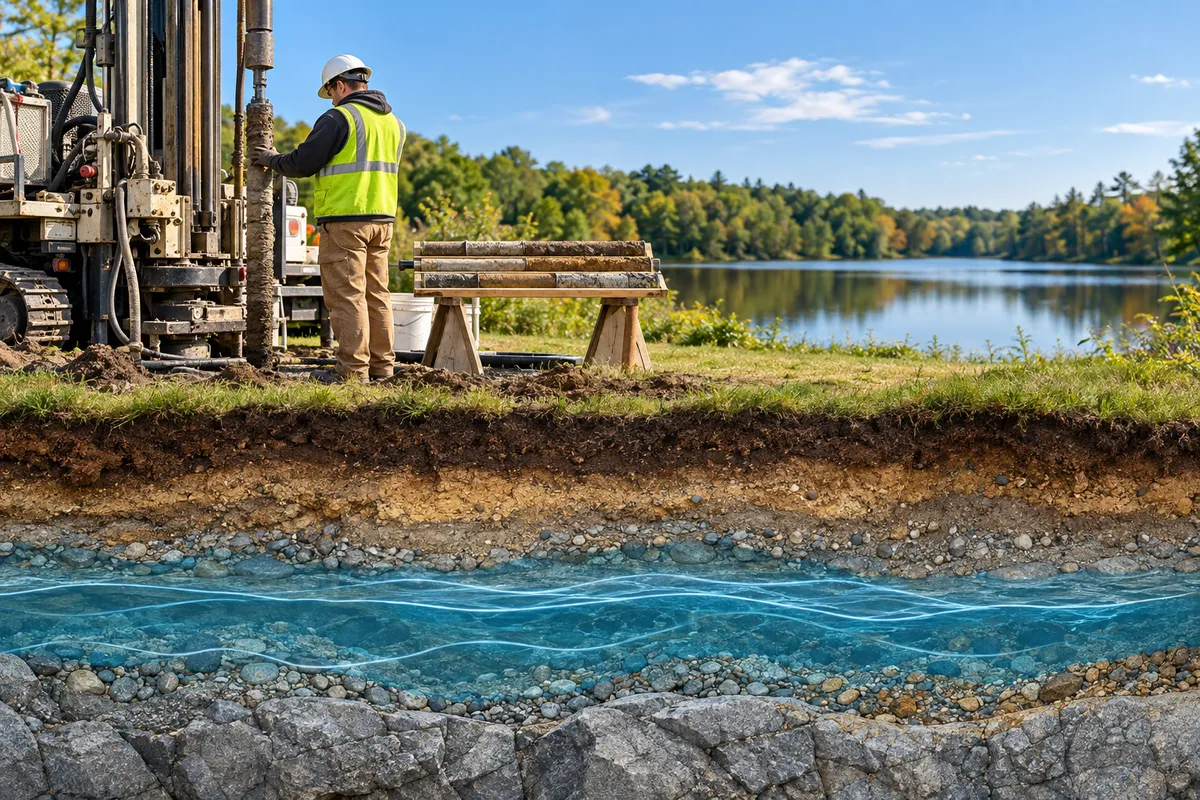
During a recent field investigation, an Edgewater Strategies team member reviewed soil samples collected through split-spoon sampling as a monitoring well was advanced. This process allows our team to examine subsurface materials at different depths and identify the soil and geological conditions that influence groundwater movement.
Different materials have different hydraulic properties. For example, water may move relatively quickly through coarse, permeable materials, while finer-grained soils can restrict the rate of groundwater movement.
Identifying these differences helps us develop a clearer understanding of how water travels through the subsurface and how wastewater may behave after it enters the ground.
Our subsurface investigations can include:
Soil sampling and classification to identify underground materials.
Monitoring well installation to evaluate groundwater conditions.
Hydraulic conductivity and other subsurface evaluations.
Aquifer testing to understand groundwater movement and storage characteristics.
Analysis of field data to support groundwater modeling and development planning.
Together, these methods provide essential information about the natural conditions that influence groundwater quality.
Monitoring Wells and Aquifer Testing
Soil samples provide valuable information about the materials beneath a property, but understanding groundwater behavior requires additional investigation.
After a monitoring well is installed, Edgewater Strategies can conduct appropriate field tests to evaluate aquifer characteristics and groundwater response.
Depending on site conditions and project objectives, these investigations may include slug tests, falling-head tests, and other aquifer testing methods. These tests help characterize how groundwater responds to changes in the well and provide information about the hydraulic properties of the surrounding formation.
This data helps our team evaluate how groundwater moves through the subsurface and supports the development of hydraulic models for proposed projects.
Accurate site-specific information is essential because groundwater conditions can vary significantly from one property to another, even within the same community.
Modeling Wastewater Movement and Nitrate Concentrations
Once field investigations are complete, Edgewater Strategies uses the collected data to evaluate how a proposed septic system may affect groundwater.
When wastewater enters the ground, it can create a localized rise in the groundwater surface, commonly referred to as a wastewater mound. The size and shape of this mound depend on factors such as the proposed wastewater loading rate, soil permeability, groundwater conditions, and the characteristics of the surrounding aquifer.
Groundwater modeling helps us estimate how wastewater may move away from the loading area and how nitrate concentrations may change as the wastewater mixes with existing groundwater.
These models allow us to evaluate questions such as:
How will groundwater respond to the proposed wastewater loading?
In which direction is groundwater expected to flow?
How could wastewater movement affect neighboring properties?
Will predicted nitrate concentrations meet applicable groundwater quality standards?
Are adjustments to the proposed system necessary to support long-term performance?
By evaluating these factors before construction, we can help identify potential concerns early in the design process and provide developers with information to make informed decisions.
Why the 10 mg/L Nitrate Threshold Matters
Nitrate is an important consideration in groundwater protection because elevated concentrations in drinking water can pose health risks, particularly for infants.
For public drinking water systems in the United States, the federal maximum contaminant level for nitrate is 10 milligrams per liter (mg/L), measured as nitrogen. New Hampshire also has applicable drinking water and groundwater protection requirements that must be considered when evaluating proposed development.
For projects where the 10 mg/L nitrate criterion applies, groundwater modeling can help assess whether predicted concentrations could exceed the applicable threshold at property boundaries or other required compliance locations.
The objective is to evaluate potential impacts before a septic system is installed and determine whether the proposed design can satisfy applicable regulatory requirements.
Actual compliance criteria depend on the project, the type of water resource being protected, and the relevant state and local regulations. Groundwater modeling is therefore an important planning tool, but it must be supported by reliable field data, appropriate assumptions, and the applicable regulatory framework.
Helping Developers Design Sustainable Wastewater Systems
Groundwater investigations are not intended to prevent development. They help make development more informed and sustainable.
By understanding site-specific soil conditions, aquifer characteristics, and groundwater flow patterns, Edgewater Strategies works with developers to evaluate wastewater loading rates and identify design approaches that account for the property's natural limitations.
This process can help developers:
Make informed decisions about site suitability.
Evaluate potential groundwater quality impacts before construction.
Identify design adjustments that may be needed to address site conditions.
Support compliance with applicable town and state requirements.
Reduce the risk of costly design changes later in the project.
The result is a more informed approach to development that considers both project goals and the long-term protection of groundwater resources.
Protecting Drinking Water Through Responsible Development
Groundwater protection begins long before a property is developed. It starts with understanding the soil, geology, and groundwater conditions that determine how water moves beneath the surface.
Through soil sampling, monitoring well installation, aquifer testing, and hydraulic modeling, Edgewater Strategies helps communities and developers evaluate potential impacts and plan wastewater systems with groundwater protection in mind.
By combining field investigations with engineering analysis, we help turn subsurface data into practical information that supports responsible development and long-term water quality protection.
Planning a Development Project?
Whether you are evaluating a potential development site or assessing groundwater conditions, Edgewater Strategies can help you understand the subsurface factors that may influence your project.
Contact our team to learn more about our groundwater investigations, hydraulic studies, and environmental engineering services.
Visit EdgewaterNH.com to get started.
