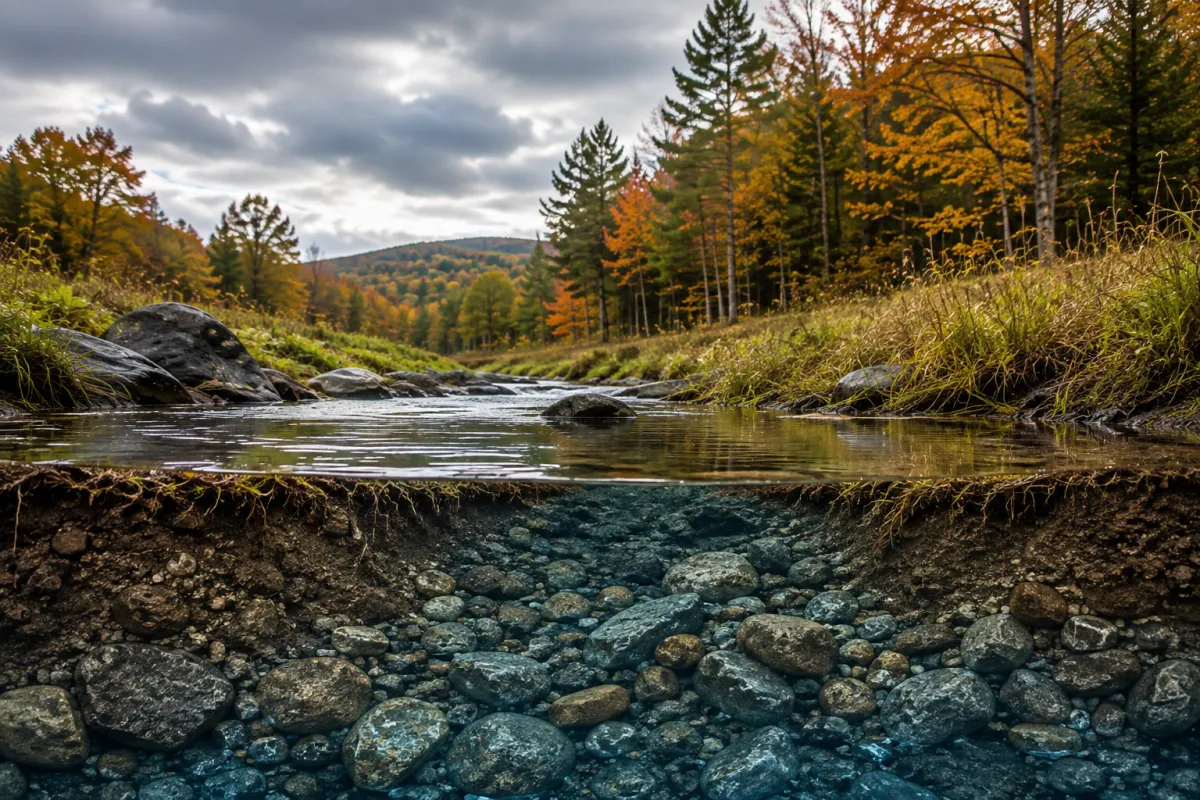
From Summer Drought to Fall Rain: What Happens to New Hampshire Groundwater?
From Summer Drought to Fall Rain: What Happens to New Hampshire Groundwater?
When the rain returns after a dry summer, the landscape may look refreshed—but what is happening below the surface?
After a summer of dry weather, the arrival of fall rain can feel like an immediate relief. Streams begin flowing more steadily, lawns regain some color, and puddles return to places that have been dry for months.
But groundwater doesn't respond to rainfall quite as quickly as we might expect.
For New Hampshire homeowners, communities, and businesses that depend on groundwater, understanding what happens beneath the surface can provide important insight into water availability, wells, drainage, and long-term water resource planning.
At Edgewater Strategies, we specialize in understanding the relationship between groundwater, geology, surface water, and land use. Here's a closer look at what happens to New Hampshire's groundwater as we transition from summer drought conditions into fall.
First, Where Does Groundwater Come From?
Groundwater is water stored beneath the ground in spaces and fractures within soil, sand, gravel, and bedrock.
It primarily comes from precipitation that infiltrates into the ground. Some rainwater runs across the surface into streams, ponds, and lakes. Some is taken up by vegetation or returned to the atmosphere through evaporation and transpiration. The remaining water can move downward through the soil and eventually contribute to groundwater recharge.
In New Hampshire, groundwater is particularly important. According to the New Hampshire Department of Environmental Services, groundwater supplies drinking water for approximately 60% of the state's population. Groundwater also helps replenish rivers, lakes, and wetlands during dry periods.
That means what happens below the ground can have a significant impact on the water we see above it.
What Happens During a Dry Summer?
During a prolonged period of below-normal precipitation, groundwater levels can decline.
There are several reasons for this.
Plants continue using water throughout the growing season, evaporation removes water from the soil, and people continue withdrawing groundwater from wells. If water is leaving the system faster than precipitation is replenishing it, groundwater levels can gradually fall.
New Hampshire has experienced periods when drought conditions have affected groundwater levels, private wells, public water supplies, and surface waters. During drought conditions, monitoring wells across the state have shown declines, and water users may be asked to reduce withdrawals or implement conservation measures.
Importantly, groundwater doesn't necessarily reach its lowest point at the exact moment a drought is most noticeable.
There can be a delay between a lack of rainfall and a measurable change in groundwater levels.
Then Fall Rain Arrives. What Happens Next?
When fall rain returns, some of that precipitation begins infiltrating into the ground.
But not every drop becomes groundwater.
How much water actually reaches the groundwater system depends on several factors, including:
Soil type and thickness
Geology and bedrock
Amount and intensity of rainfall
Existing soil moisture
Vegetation
Land cover and impervious surfaces
Topography and drainage patterns
A slow, soaking rainfall may provide better conditions for infiltration than a short, intense storm that produces significant surface runoff.
This is why one rainy weekend doesn't necessarily erase the effects of a dry summer.
Groundwater recharge is a process, not an event.
Fall Rain Can Help—but Recovery Takes Time
Think of groundwater like a savings account.
During a wet period, water is deposited into the account through recharge. During dry periods, water continues to be withdrawn through wells, natural discharge to streams and wetlands, evaporation, and plant use.
A few deposits can help, but rebuilding the balance after an extended period of withdrawals can take time.
This is especially important when looking at groundwater availability for private wells, public water systems, irrigation, or new development.
New Hampshire DES notes that groundwater availability can be affected by climate, changes in land cover and topography, and groundwater withdrawals.
In other words, precipitation is only one piece of the puzzle.
Why Your Property May Look Different in the Fall
You may notice something interesting as fall progresses: areas of your property that looked completely dry during the summer may become wet again.
A low spot may begin holding water.
A previously dry drainage path may become active.
A small seep may appear along a slope.
These changes can provide clues about how water moves through your property.
Groundwater doesn't move evenly beneath the landscape. Local geology, soil conditions, elevation, and natural drainage pathways all influence where water travels.
A wet area that appears after several weeks of rain doesn't necessarily indicate a problem. It may simply be revealing a natural groundwater or drainage feature that isn't visible during drier conditions.
Groundwater and Surface Water Are Connected
One of the most important concepts in understanding groundwater is that it doesn't exist in isolation.
Groundwater and surface water—such as lakes, ponds, rivers, and wetlands—are often closely connected.
During dry periods, groundwater can help sustain stream and wetland flows. Conversely, surface water can contribute to groundwater recharge under certain conditions.
That connection is particularly important in New Hampshire, where the state's groundwater resources play an important role in supporting both drinking water supplies and aquatic ecosystems.
This is also why land-use decisions matter.
Changes to a property—such as increased impervious surfaces, altered drainage, excavation, or development—can change how much water infiltrates into the ground and where runoff travels.
What Does This Mean for Private Wells?
For homeowners who rely on private wells, groundwater conditions are especially important.
A well doesn't create water. It accesses water that is already present in the surrounding groundwater system.
During periods of low groundwater levels, some wells may experience reduced yield or other changes in performance. The impact can vary considerably depending on the well's construction, depth, location, surrounding geology, and groundwater conditions.
If you're experiencing changes in your well—particularly following an extended dry period—it's worth paying attention to those changes rather than assuming they will resolve immediately with the next rainfall.
Understanding the underlying hydrogeology can help determine whether a problem is temporary, seasonal, or indicative of a larger issue.
Fall Is a Good Time to Pay Attention
As we move into fall, homeowners and water resource managers can learn a lot simply by observing what changes after rainfall.
Pay attention to:
💧 Groundwater-dependent areas
Do springs, seeps, streams, or wetlands appear different than they did earlier in the summer?
🌧️ Drainage patterns
Where does rainwater travel across your property? Are there areas where runoff concentrates?
🏡 Private wells
Have you noticed any changes in well performance following a dry summer?
🌿 Wet and dry areas
Are there parts of your property that remain unusually wet or dry?
🏞️ Nearby surface water
How are ponds, lakes, streams, or wetlands responding to changing precipitation?
These observations don't replace professional evaluation, but they can provide useful information about how your property responds to changing water conditions.
The Bigger Picture: Water Resource Planning
For homeowners, seasonal groundwater changes may simply mean noticing a wet area in the yard or keeping an eye on a private well.
For municipalities, developers, farms, golf courses, ski areas, and other water users, the implications can be much larger.
Planning for reliable water supplies requires understanding both current conditions and how groundwater responds over time.
That's where hydrogeology comes in.
At Edgewater Strategies, we work with public water systems, developers, municipalities, and other water users on groundwater resources, including groundwater monitoring, new development planning, drinking water withdrawal permits, irrigation withdrawals, and water treatment design.
Our goal isn't simply to look at where the water is today. It's to understand how water moves, where it comes from, how it is being used, and what those patterns mean for the future.
Fall Rain Is Just One Part of the Story
The return of rain after a dry summer is good news—but groundwater recovery doesn't happen overnight.
Water needs time to infiltrate through the landscape, recharge groundwater systems, and move through the complex network of soil, rock, wetlands, streams, lakes, and aquifers beneath our feet.
For New Hampshire, understanding that process is increasingly important as communities plan for reliable water supplies, homeowners manage private wells, and development continues to change the landscape.
Because when it comes to groundwater, what happens above the surface is only part of the story.
Need Help Understanding Your Water Resources?
Whether you're planning a new development, evaluating a groundwater resource, monitoring a well, or navigating water-use permitting, understanding the hydrogeology of a site is an important first step.
Edgewater Strategies brings practical hydrogeologic expertise to water resource challenges throughout New Hampshire.
Have a water resource question? Contact Edgewater Strategies to learn how we can help.
