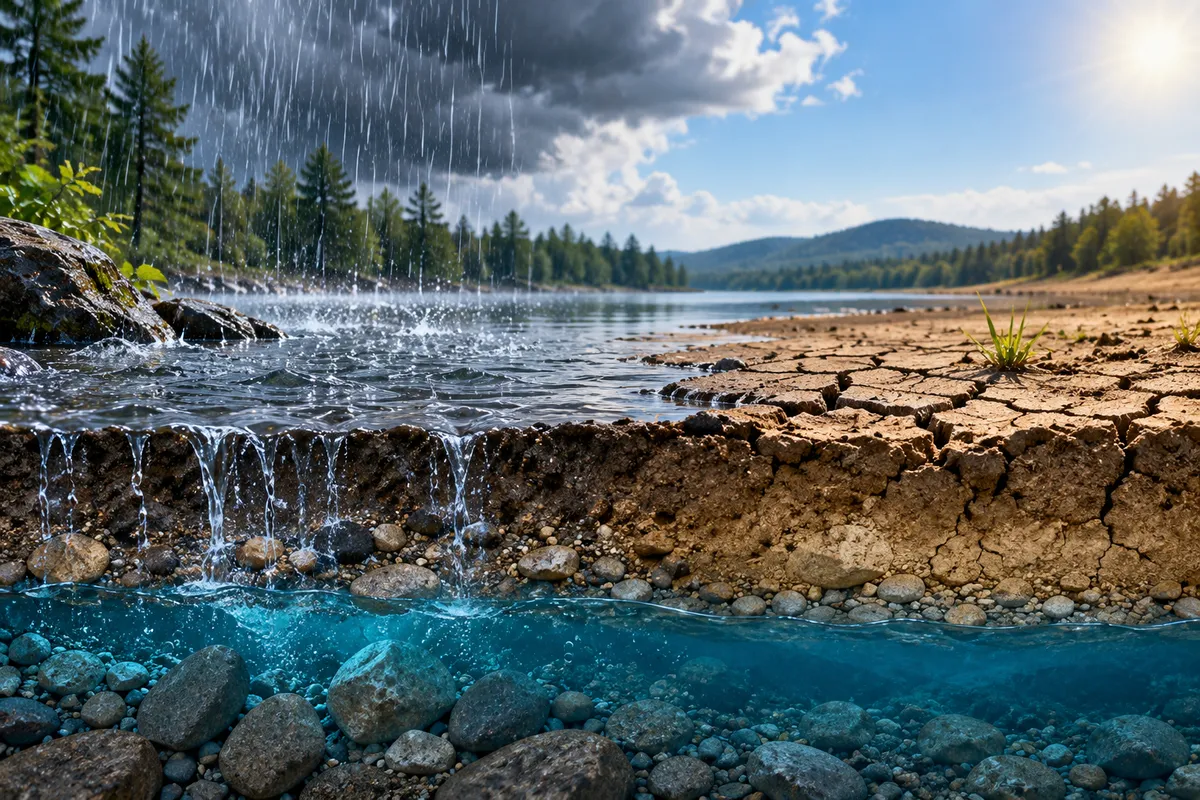
Why More Rain Doesn’t Always Mean More Water: What New Hampshire’s Groundwater Crisis Can Teach Us
When New Hampshire gets a heavy rainstorm, it can feel like the landscape is getting the water it needs.
Streams rise. Ponds and lakes fill. Lawns turn green. Puddles appear almost overnight.
But beneath the surface, the story can be much more complicated.
New Hampshire is becoming warmer and wetter overall, yet the state is also experiencing periods of drought and water-supply stress. As of early September 2026, approximately 540,700 New Hampshire residents are living in areas experiencing drought, according to the U.S. Drought Monitor.
So how can a state receive more rain overall and still experience groundwater concerns?
The answer comes down to more than how much rain falls. It also depends on when it falls, how intensely it falls, where it goes, and how much actually has a chance to infiltrate into the ground.
More Rain Doesn't Necessarily Mean More Groundwater
Groundwater is replenished through a process called recharge. When precipitation reaches the ground, some of that water infiltrates through soil and eventually makes its way down to the water table.
But not every drop of rain becomes groundwater.
Some precipitation is absorbed by plants. Some evaporates back into the atmosphere. Some flows across the surface as runoff and eventually reaches streams, rivers, ponds, and lakes.
And when rainfall comes down faster than the landscape can absorb it, a greater percentage may run off rather than infiltrate.
That distinction is becoming increasingly important in New Hampshire.
Recent research from Dartmouth College found that rainfall events are becoming more concentrated, with more intense storms occurring in clusters and longer periods between precipitation events. Researchers found that this pattern can have a drying effect on the landscape, even when total precipitation increases.
New Hampshire State Climatologist Mary Stampone has similarly noted that rainfall in New Hampshire is becoming more concentrated, with longer dry periods between events. When a large amount of rain falls all at once, soils may not be able to absorb it quickly enough, resulting in increased runoff rather than groundwater recharge.
In other words:
More rain does not automatically equal more water available for our groundwater systems.
Think About a Sponge
Imagine placing a sponge underneath a faucet.
If water drips slowly onto the sponge, the sponge has time to absorb it.
But if you dump a bucket of water onto it all at once, some of that water will run off before the sponge can absorb it.
The ground works in a similar way.
A slower, soaking rainfall gives water more opportunity to infiltrate through soil and contribute to groundwater recharge. An intense storm can overwhelm the ability of soil to absorb water, sending more of it across the surface.
This doesn't mean intense storms provide no groundwater recharge. Some of the water can still infiltrate. But the amount that ultimately reaches groundwater depends on many factors, including soil characteristics, geology, vegetation, topography, land cover, and the intensity and duration of the rainfall.
New Hampshire's groundwater systems are especially complex because water moves through a variety of soils, sands, gravels, and fractured bedrock.
What Happens Between the Storms Matters, Too
The other side of the equation is what happens when it isn't raining.
Longer periods of warm, dry weather can increase evaporation and evapotranspiration—the process through which plants release water back into the atmosphere.
That means water can leave the landscape between storms.
Recent New Hampshire research has highlighted this combination: heavier rainfall events can produce more runoff, while longer dry periods and warmer temperatures can increase water loss from soils and vegetation. Together, those factors can make it more difficult for precipitation to translate into lasting groundwater recharge.
This helps explain one of the state's most important water-resource challenges: New Hampshire can experience both intense rainfall and drought.
Those conditions may sound contradictory, but from a groundwater perspective, they can occur at the same time.
New Hampshire's Groundwater Matters
Groundwater isn't an invisible resource that only concerns scientists and engineers.
It is an important source of drinking water for homes, businesses, and communities throughout New Hampshire.
Groundwater also supports streams, wetlands, ponds, and lakes, particularly during periods when precipitation is limited.
USGS research on New Hampshire's Seacoast aquifer system has demonstrated just how seasonal groundwater recharge can be. In the Seacoast region, recharge varies substantially throughout the year, with particularly important recharge occurring during late fall, winter, and spring.
That seasonal pattern matters when we think about long-term water availability.
A few inches of rain during an intense summer storm may create dramatic surface-water changes without providing the same groundwater benefit as precipitation that falls gradually during conditions that favor infiltration.
Land Use Matters, Too
Rainfall is only one part of the groundwater equation.
What happens on the land can influence where that water goes.
As properties are developed, natural landscapes can be replaced with rooftops, pavement, driveways, parking areas, and other impervious surfaces. These changes can alter drainage patterns and increase the amount of water flowing over the surface.
That makes understanding a property's existing water resources especially important before development begins.
Questions worth asking include:
Where does groundwater occur beneath the property?
How does water naturally move across the site?
Are there wetlands, streams, or other sensitive resources?
Where does stormwater go during a heavy rain?
How much precipitation can infiltrate into the soil?
Could a proposed project change groundwater recharge or runoff patterns?
Is there enough water available to support a proposed use?
These aren't simply construction questions. They're water-resource questions.
This Is Where Edgewater Strategies Comes In
Understanding New Hampshire's water resources requires more than looking at a rainfall total.
At Edgewater Strategies, we look at the bigger picture: the relationship between groundwater, geology, surface water, land use, and development.
Our work includes groundwater monitoring, new development planning, drinking water withdrawal permitting, irrigation withdrawals, water treatment design, and support for public water systems. We also help communities and developers navigate water-resource considerations as they plan for future needs.
That means helping clients answer questions such as:
Is there enough groundwater available for the proposed use?
How might development affect water resources?
What environmental resources need to be considered?
What permitting may be required for a new or expanded water supply?
What information is needed to understand groundwater conditions over time?
How can public water systems become more resilient and reliable?
Our role is not simply to tell clients where the water is today. It's to help them understand how water moves through a site, how it is being used, and what those conditions could mean for a project or community in the future.
Planning for a Changing Water Future
New Hampshire's recent water challenges offer an important lesson:
We can't measure water security by rainfall alone.
A year with more precipitation can still bring groundwater challenges if that precipitation arrives in intense storms separated by long periods of dry weather. Likewise, a single large storm may temporarily raise streams and lakes without fully addressing longer-term groundwater deficits.
As precipitation patterns change and communities continue to grow, understanding groundwater and planning for water availability will become increasingly important.
For homeowners, that may mean understanding how a private well responds to changing conditions.
For developers, it may mean evaluating groundwater availability before moving forward with a project.
For municipalities and public water systems, it may mean investing in monitoring, conservation, infrastructure, or additional water resources.
And for all of us, it means recognizing that water doesn't simply disappear when it falls from the sky.
It moves.
It infiltrates.
It runs off.
It evaporates.
It enters groundwater.
And ultimately, those pathways determine how much water is available when we need it.
Understanding the Water Beneath the Surface
New Hampshire's water future depends on understanding that entire system—not just how much rain falls in a given month or year.
At Edgewater Strategies, we help communities, developers, public water systems, and other water users better understand their water resources and plan responsibly for the future.
Because when it comes to water, the question isn't just:
“How much rain are we getting?”
It's:
“Where is that water going—and will it be there when we need it?”
Learn more about groundwater resources, water systems, and water-resource planning with Edgewater Strategies.
